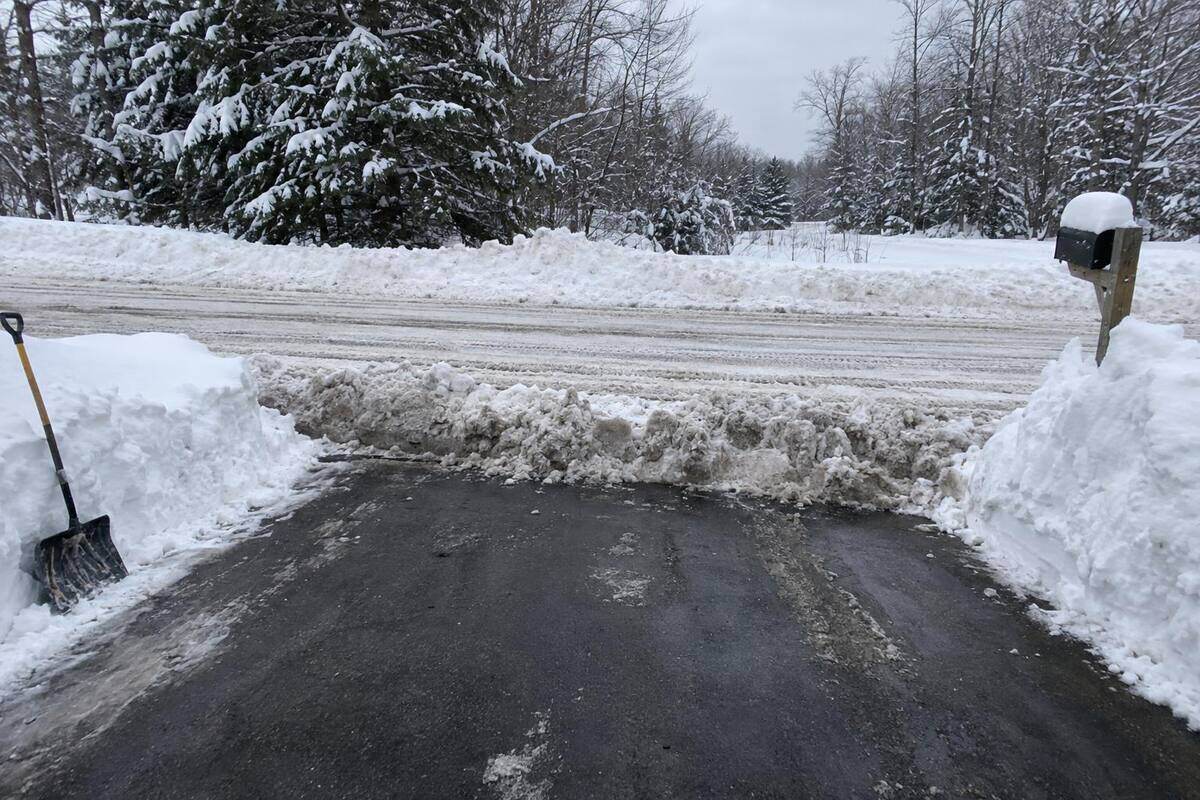
The drive was clear at 6 a.m. By 9 there is a ridge of heavy, packed snow across the end of it, left by the road commission truck. That ridge is the most common complaint in this trade, and almost nobody around Traverse City talks about it in writing.
Traverse City Snow Plowing is a referral service. A return pass for the berm, like every other visit, is made by the independent contractor you hire, under that contractor’s name and insurance; this site introduces you and does no clearing of its own.
“As snow and ice is moved away from the road, it is inevitable that some will be deposited at the ends of driveways.”
Grand Traverse County Road Commission, FAQThat is the plain truth of plowing a road with a truck. The blade throws snow to the shoulder, and a driveway is a gap in the shoulder, so the snow fills it. The road commission does not come back to clear driveway ends. Its practical advice to homeowners is to put driveway snow on the right side of the drive as you face the road, and never out in the road itself.
The city of Traverse City says much the same about its own streets: please do not push or place snow into the street or alley; put it on the tree lawn or on your own property.
The Grand Traverse County Road Commission runs about 1,200 miles of winter roads on 31 plow routes, putting 35 to 40 trucks out per event from garages in Kingsley and Traverse City. Leelanau’s road commission runs 28 drivers day and night. Both work in priority order, and in Grand Traverse the order is written down: state highways first, then primary roads, then secondary, local, subdivision and gravel roads, in that order.
This is not anyone doing a bad job. It is two separate crews working the same storm in the only order that makes sense for each of them. The problem is simply that the second pass undoes the end of the first.
No local operator publishes an answer. Some contracts may include a second visit after the road has been plowed, some may bill it as a separate visit, and some may not offer it at all, leaving the apron to you. The only way to know is to ask before the season starts and have the answer written into the agreement.
Three things are worth settling at the same time:
Does the contractor come back whenever the county plow has been by, or only when you call? For an empty house, only the first works.
The same morning, or on the next route? A ridge left overnight freezes, and the harder it gets the longer it takes.
Onto your side of the right-of-way, on the side the road commission advises, clear of the mailbox and the sight line.
For a second home, the return pass is often the difference between a drive a propane truck can enter and one it cannot. The vacant-property page covers access for deliveries and emergency vehicles, and the contracts page lists the other terms to settle in October.
The fast way to get rid of a berm is to shove it across the road into the far ditch. That is illegal in Michigan, for you and for anyone you hire.
“A person shall not deposit, or cause to be deposited, snow, ice or slush on any roadway or highway.”
MCL 257.677a(4)The same statute bars moving snow onto or across a road or its shoulder in a way that blocks “safety vision,” which it defines as an unobstructed line of sight that lets a driver travel on, enter or leave a road safely. Violation is a civil infraction with a fine of up to $100. The law exempts the state and its subdivisions, which is why the county truck can do what a private plow cannot. And “cause to be deposited” reaches the owner who hired the plow, not only the driver.
In the Village of Suttons Bay the rule has more teeth. Snow Removal Ordinance 12 of 2004, Section 4, bars depositing snow or ice removed from private driveways or property on any public street, sidewalk or right-of-way, with a fine of up to $500 and each day counted as a separate violation. More on the Suttons Bay page and the local rules page.
One more piece of road law for storm mornings: Michigan drivers must stay at least 200 feet behind a working snowplow, with a $100 fine. That applies on the way out of the drive, too.
Both road commissions draw the same line. They help when their equipment struck the mailbox. They do not help when it went over under the weight of plowed snow or ice, which is the more common way a box comes down. Leelanau’s road commission also sets a placement standard: the face of the box a minimum of 6 feet off the edge of the blacktop, or 1 foot behind the road shoulder, and it advises against plastic boxes.
A contractor clearing the berm works right next to the post. Point it out on the pre-season visit, and if the box sits closer to the road than the standard, fix that in the fall rather than in February.
Get matched with an operator who will say in writing what happens after the county truck has been by.
Call (231) 715-4148 Get a Season Price Traverse City