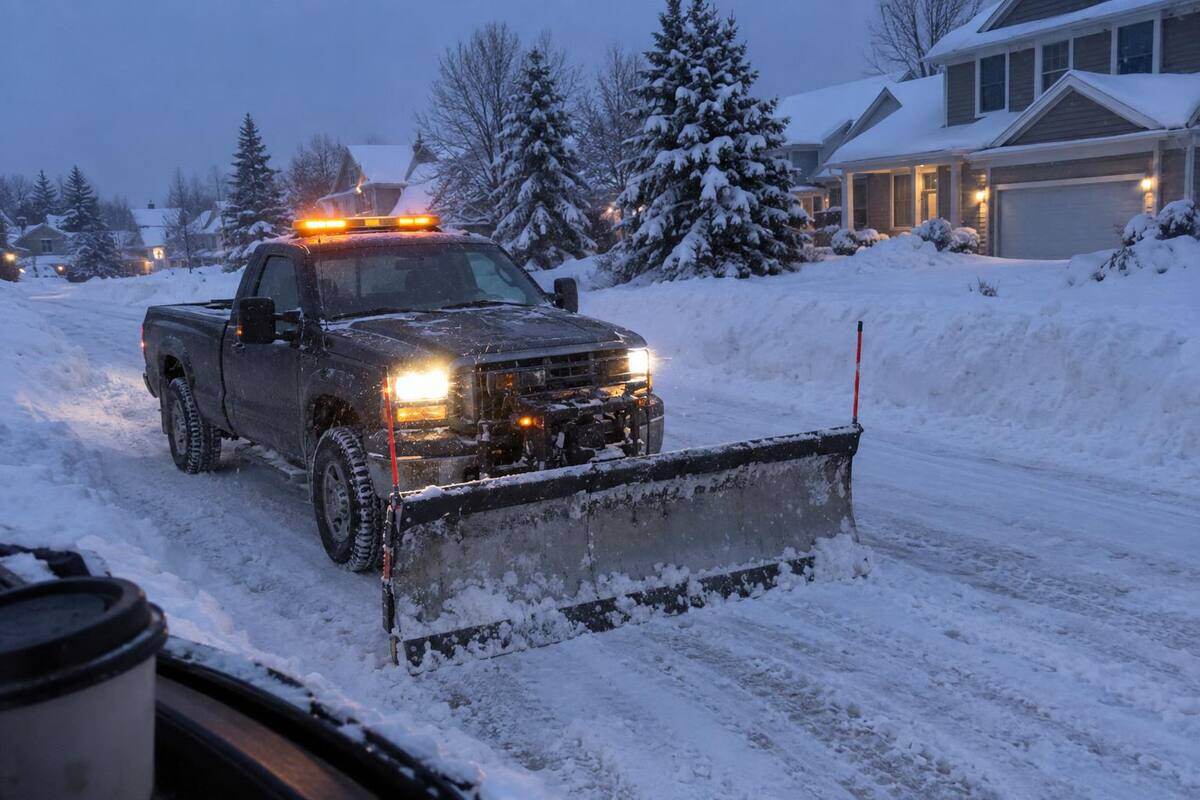
Around Traverse City the real choice is not between two prices. It is between being on a route and not being on one. Operators here sort customers into route accounts and on-call calls, and in a storm the on-call list waits until the route is done.
Traverse City Snow Plowing is a referral service. The season contract you sign is with an independent local operator, who plows, shovels and salts under its own name and its own insurance; this site only makes the introduction.
One Suttons Bay-area operator writes the split down plainly, and the rest of the market behaves the same way whether it says so or not. Route clients have an account, a place in the storm-night order and a monthly invoice. On-call clients phone when they want a visit and pay before the work is done. They have no route slot.
On a quiet two-inch night the gap between the two is small. On a night like March 15–16, 2026, when the airport logged 13.3 inches in a day and a co-op site southeast of town logged 19.8, it is the whole difference. A driver with a full route to finish before sunrise does not leave it to open an on-call driveway, and nobody should expect that. An on-call customer in a storm is behind every route customer that operator has.
| Route account | On-call | |
|---|---|---|
| Place in a storm | In route order, set before the season | After the route is finished |
| How it is billed | Season, monthly or by snowfall, usually invoiced | Paid before service |
| Who decides to send the truck | The trigger in the contract | You, by calling |
| Available in January | Only if the route has room | Usually, at the back of the line |
Thirteen local operator sites were read in building this one. The structures they sell fall into three shapes, and one operator lists all three side by side with seasonal marked as its most popular.
One agreement for the winter, covering every event over the trigger. The operator carries the risk of a heavy year and you carry the risk of a light one. This is the plan most route customers are on.
The same route slot, billed month by month. It spreads the cost across the winter and is common among the Traverse City operators; one also offers financing on its contracts.
Billed per visit, sometimes with rates stepped by how much fell. It exists, but it is the minority choice here, and without a route account it can mean on-call status.
No local operator publishes the dollar figure behind any of these. Every one of them quotes by the property, and the thing that moves the quote most is the driveway: length, turnaround and complexity, in one operator’s own words. The pricing page sets out that structure, and the long-driveway page covers the driveway classes in detail.
The trigger is the depth at which your contract sends the truck without a phone call. Two inches is the only trigger any operator around here publishes; others set it contract by contract. A trigger that exists only in a phone conversation is not a trigger, so have the number written into the agreement, along with whether it is measured at your house or at some reference point the operator uses.
The same operator that publishes the 2-inch figure runs residential routes from 3 to 9 a.m. That is the shape of the job everywhere in this market: the route runs in the dark so drives are open before people leave for work. In the city, the overnight parking ban from November 16 to April 14 takes cars off the street between 3 and 6 a.m., so the driveway is where the car has to be when the route arrives.
A season price is really a price for a count of visits, so start with the count. NCEI’s 1991–2020 normals for Cherry Capital Airport give these figures for days with new snowfall at or above a depth:
| New snow in a day | Days a year |
|---|---|
| 0.1″ or more (any measurable snow) | 58.6 |
| 1″ or more | 32 |
| 3″ or more | 11 |
Read that against a trigger. A contract with a 1-inch trigger is written against roughly 32 qualifying days in a normal winter at the airport. A 3-inch trigger is written against roughly 11. The published 2-inch trigger falls between them; NCEI does not publish a 2-inch count, and this page will not make one up. A storm that runs across two days can be one visit or two depending on timing, which is another thing worth asking.
Two corrections to keep in mind. First, those are airport numbers, and the airport is not the snowiest ground in this market; Maple City’s long-record station averages 142.1 inches a year against the airport’s 101.4, so a Leelanau upland driveway crosses any trigger more often. The station-by-station page shows where your community sits. Second, a normal is an average of winters that were not normal. That is the next section.
The 2024–25 winter finished at 140.5 inches at Traverse City, 150% of normal, with a December of 48.2 inches that was the second-snowiest on record. Then 2025–26 went further: about 145 inches by April 1, 53 of them in January alone, and 88 days with six inches or more on the ground against a typical 57. It ended with the March blizzard that the Ticker called the city’s snowiest single storm on record.
Two winters like that change who is shopping. The people calling operators this fall are, in large part, the ones who spent last January behind a snowblower and decided once was enough. Nobody can tell you in October whether 2026–27 will be a third heavy winter or a light one. The record here is 191.5 inches, set in 1995–96, so heavy is not unusual. A season contract is a way of not having to guess.
No operator here publishes a sign-up deadline. What they publish instead is some version of the same warning: routes fill, openings are limited, sign up early. That is the capacity problem in this trade. One truck and one driver can only cover so many drives between 3 and 9 a.m., and once a route is built the operator does not squeeze in a customer who calls in January.
For a second home, add the pre-season visit. Several local operators stake driveways before the first snow, and an absentee owner needs that done while someone can still see the edges of the drive and the culverts. The vacant-property page covers what else belongs in that first visit.
Ask for a certificate of insurance while you are at it. Michigan has no state license for snow contractors, so insurance is the credential that means something.
Give the address, the driveway and the trigger you want, and you will be introduced to an operator with room on a route that passes the house.
Call (231) 715-4148 Get a Season Price Traverse City