Snow sits on roofs here for a long time. At the airport there are about 98 days a year with at least an inch on the ground, and last winter there were 88 days with six inches or more. This page is about watching that load from the yard, knowing what you are looking at, and handing the roof to someone insured to work on it.
Traverse City Snow Plowing is a referral service. It does not clear roofs, plow drives or spread salt; any roof work is done by an independent roof-snow contractor under its own name and its own insurance, and nothing on this page is an instruction to go up there yourself.
Michigan’s Residential Code, as adopted in Mich. Admin. Code R 408.30515, sets the ground snow load for all of Grand Traverse and Leelanau counties at 60 pounds per square foot. Benzie and Kalkaska carry the same figure. It is the code writing the lake-effect climate into a table.
It is easy to misread. Sixty psf is a number an engineer or builder starts from when designing a new house. It is not a rating stamped on your roof. Roofs are built to their own design, age and repair history, and a great deal of the lake-home stock here began as seasonal cottages that were winterized later, often before the current table existed. A steep metal roof on a newer house and a low-pitched roof on an older cottage are not the same structure, and the code number says nothing about which one you have.
These figures come from the Insurance Institute for Business & Home Safety, as published by the U.S. Department of Energy’s Building America program. They are approximations, but they are useful for understanding why a roof that looked fine in December can be in trouble in March.
| What is on the roof | Approximate load |
|---|---|
| 10–12″ of new snow | about 5 psf |
| 3–5″ of old, packed snow | about 5 psf |
| 1″ of ice | about the same as 1 ft of fresh snow |
| Where many roofs begin to show stress | around 20 psf |
The pattern that matters is layering. Fresh snow is light. Snow that sits, settles, gets rained on and refreezes is not. After a winter like 2025–26, when the airport took about 145 inches by April 1, the load on a roof that never shed is mostly old pack and ice, and those weigh far more per inch than the snow that just fell.
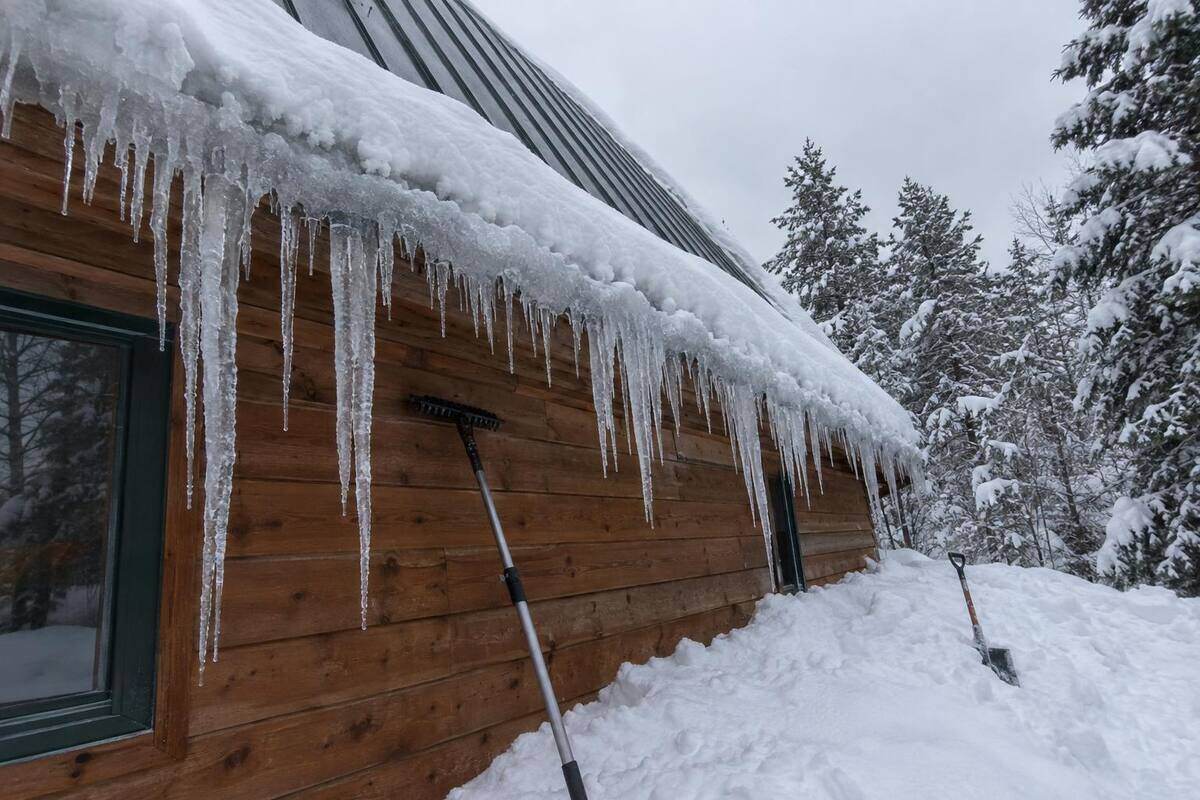
An ice dam starts inside the house. Heat escaping into the attic warms the roof deck above freezing, the snow on it melts, and the meltwater runs down to the eave, which hangs out past the heated walls and stays cold. There it freezes. The ridge of ice grows, later melt pools on the uphill side of it, and water that should have run off sits on the roof and works its way under the covering.
The University of Minnesota Extension calls air leakage into the attic “the major mode” of heat loss behind ice dams, and IBHS puts the lasting fix in the attic, not on the roof: ventilation, insulation and air sealing. Michigan State Police’s MIREADY program recommends at least R-30 attic insulation, with R-38 preferred in northern Michigan, along with clear gutters and a roof rake. Michigan’s insurance regulator, DIFS, lists ice dams, roof collapse and frozen pipes among the state’s most frequent winter claims.
Heavy icicles along the eave, especially thick ones that keep growing, are the visible edge of an ice dam. They mean meltwater is reaching a cold edge and freezing there.
Stand back and look along the ridge and the eaves. A dip, a sag or a roofline that is no longer straight is one of the signs Extension guidance lists for a roof under too much load.
Sidewalls pushed outward near the top are another sign on that list. They are easiest to see by sighting along the wall from a corner of the house.
Water stains on a ceiling or an upper wall, or visible damage to ceilings or trusses, can mean an ice dam is leaking or the structure is working. If you see signs of damage, Extension guidance is not to enter the building while the snow is still on the roof, and to call professionals.
None of these requires a ladder. All of them can be seen, and photographed, from the driveway.
This follows from the mechanism rather than from any count. A house kept at a low heat setting over the winter warms its roof less, so it tends to form fewer ice dams than an occupied one. But the snow on it also melts less, so the load sits and builds. And in an empty house, nobody walks under a sagging ceiling or notices a stain on the upstairs drywall.
That is the case for having someone look. Across the region, about a quarter of all housing is seasonal and roughly 8% of it is occupied in winter, and on Old Mission, where short-term rentals are banned, a second home can sit untouched from fall to spring. A plow operator is often the only person who sees the house after every storm. The vacant-property page covers how that visit can include the roof.
IBHS names a roof rake used from the ground as the safe option for a homeowner: a long-handled rake that pulls snow off the lower part of the roof while you stand in the yard. Even that carries cautions. The University of Minnesota notes that a rake may damage roofing materials, and IBHS warns to stay well clear of where power lines come into the house. Stay off the roof, and off a ladder at the eave. Extension guidance is blunt that anyone on a roof in winter, or working on one from below, risks injury.
Beyond a rake from the ground, roof snow is a contractor’s job. Leelanau County publishes its own list of local snow contractors, and five of the eleven on it advertise roof snow removal. Whoever you use, ask for a certificate of insurance that covers roof work specifically. Michigan has no state license for snow contractors, so insurance is what to check.
Settle this when you arrange the season contract, alongside the trigger and the return pass for the berm. For how much snow a given part of the county normally sees, see where the snow falls.
Arrange a plow contract that includes a roofline photo on every visit, and a referral when the roof needs more than watching.
Call (231) 715-4148 Get a Season Price Traverse City