About one house in four around Traverse City is a seasonal home. The average one is used 86 days a year, and in a winter month roughly 8 percent of them have anyone inside. A driveway contract written for a family that is home every night is the wrong contract for a house that is dark from the last October weekend to the first warm one in May. This is the other contract.
Traverse City Snow Plowing is a referral service. The plowing, the photograph and the phone call about your roof all come from an independent northern Michigan contractor working under their own name and insurance; this site arranges the contract that requires them and does none of the work itself.
The numbers are lopsided and worth knowing before you shop. In Glen Arbor Township there are about three seasonal units for every year-round household. In Leland Township roughly 56 percent of housing units are not occupied year-round; across Leelanau County as a whole it is about 39 percent, in a county where nearly nine in ten of the people who do live there own their home and more than a third are over 65. The Leelanau shore is where the vacant-house contract is a mass market.
Peninsula Township looks different on paper — 90 percent owner-occupied, a median age of 58, the highest incomes in the region — but it has one rule no Leelanau township has: it bans short-term rentals outright. Renting a house for under 30 days anywhere outside commercial zoning is a violation, at $500 for the first, then $750, $1,500 and $5,000, each day counted separately. So an Old Mission second home is not just usually empty in winter. Nobody may be in it. It is the purest vacant-property case in the market.
Traverse City itself is not where the dark houses are. Housing North’s regional assessment says seasonal housing is not a large share of the city’s stock, and the city’s own concern in 2026 is the sidewalks in front of the second homes it does have. The community pages carry the figure for each place.
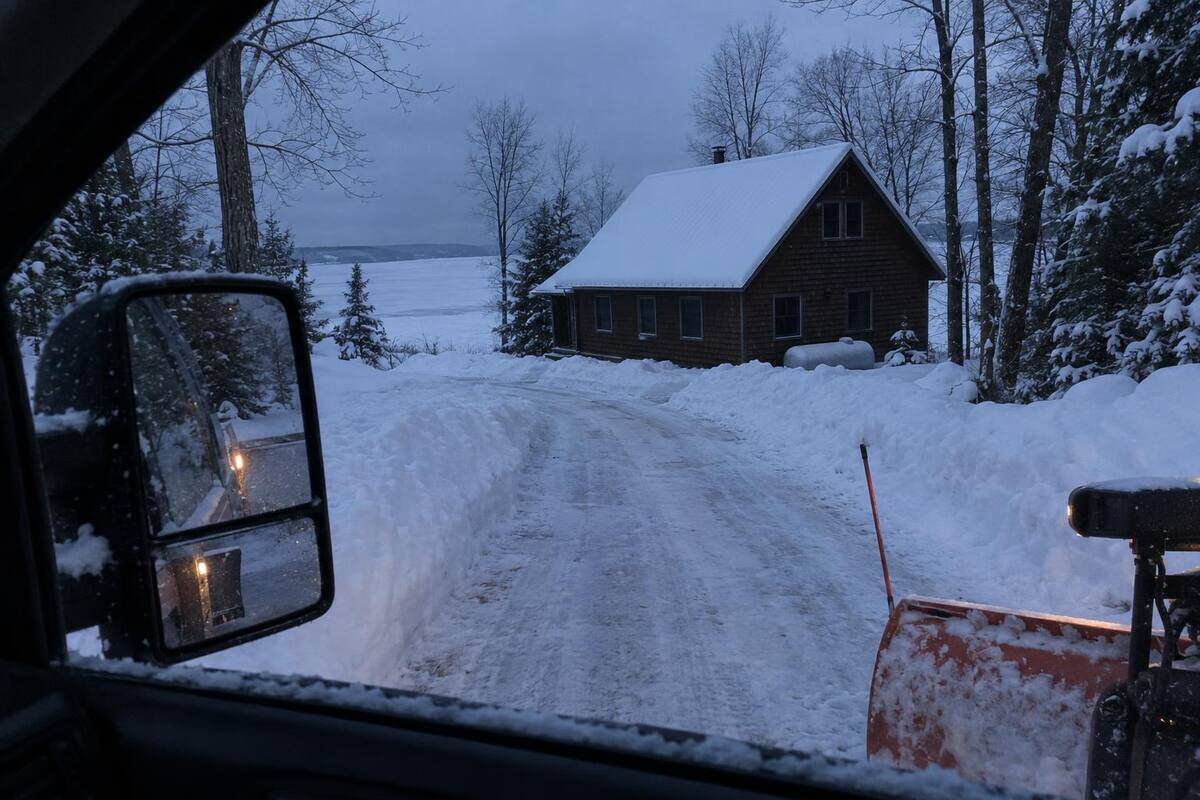
The driveway contract every operator sells is built on one assumption: someone is home, and they will call if something is wrong. Take that person away and the contract has to carry more. The version this site arranges is written around five things a year-round contract does not need.
Neither county road commission plows a designated seasonal road between November and April. Grand Traverse County’s says it plainly: private landowners perform their own snow removal, and buyers should budget for plowing. Leelanau has 63 miles of seasonal road. If yours is one, the contract has to name the road, its length, the turnaround and whether the neighbors share it. Seasonal and private roads →
An empty house still needs the drive open for the propane truck, the home-watch visit, the furnace technician and the fire department. So the contract carries a trigger depth — two inches is the local standard — and a schedule of known dates: a delivery window, a service call, your own arrival. Access is the product. A clear apron for a commute is not.
Before the ground freezes, the contractor stakes the drive edges, the culvert ends and the turnaround, and photographs the drive, the tank pad and the roofline as a baseline. Every later photo is measured against this one.
A scheduled pass before a date you give — the weekend you are driving up, a guest’s check-in, the plumber — regardless of whether the trigger was reached. It is a different promise from “within so many hours of a storm,” and it is written as one.
Propane is common on both peninsulas outside the natural-gas footprint, and a tank the delivery truck cannot reach is a furnace that stops. The path to the tank pad, the furnace and dryer vents and the meter stay clear on every visit. A drifted-over vent is a shutdown, and in an empty house nobody hears it.
Winterizing plumbing, thermostat monitoring, interior checks and roof work. Those belong to a home-watch service, your propane supplier’s tank monitor and a roof-snow contractor with its own insurance. The plow contractor is the one who is physically there after every storm, which is why the reporting below is worth more than any of the others’ quarterly visit.
This is the whole sale to someone 250 miles away, and it is the part of the contract no local plow operator advertises. The home-watch services that work Leelanau already send photo reports after their visits. The plow contractor is at the house far more often than they are. The contract this site arranges makes the contractor report the same way.
None of this is exotic. It is the standard a good property manager already holds a plow contractor to. It is simply not what a homeowner gets by calling the number on a truck door and asking for “the seasonal.”
Grand Traverse and Leelanau counties carry a code design ground snow load of 60 pounds per square foot — a design input for new construction, not a promise about what an older cottage will hold. The arithmetic that matters is simpler: ten to twelve inches of fresh snow is about five pounds a square foot, three to five inches of old packed snow is another five, and an inch of ice weighs about as much as a foot of fresh snow. Many roofs begin to show stress around 20 psf. The airport normal is about 98 days a year with an inch or more on the ground; in the winter of 2025–26 there were 88 days with six inches or more.
An occupied house sheds some of that load through its own heat and forms ice dams in the process. A house held at 55 degrees with nobody in it forms fewer dams, but it carries its load longer, and nobody is there to see the ceiling stain or hear the door start to stick. The risk in an empty house is not a dramatic collapse. It is a load that builds for six weeks unobserved.
So the roof clause is observation and referral, and nothing else. On every visit the contractor looks at the roofline from the ground and photographs it. Sag, a roof edge built up with ice, or heavy icicles get reported the same day. When the roof needs clearing, the referral goes to a roof-snow contractor that carries its own insurance — several of the operators on Leelanau County’s own snow-removal list advertise it. No one is asked to climb a roof, work from a ladder at the eave, or rake from anywhere but the ground. Roof snow and ice dams, in full →
The insurance question every second-home owner eventually asks has a plain answer that has nothing to do with plowing. Most homeowner policies exclude freeze damage to plumbing and heating unless the owner maintained heat in the building or shut off the water supply and drained the system. Michigan’s Department of Insurance and Financial Services says to keep the heat set to at least 55 degrees when away for long stretches, and to have someone check on the house; it names frozen pipes, roof collapse and ice dams among the state’s most frequent winter claims. Collapse from the weight of ice and snow is covered by standard policies. Read yours — this site is not your agent, and no insurer was found that requires or discounts for periodic property checks.
The plow contractor is not the plumber and does not winterize. But heat-on-or-drained only works if someone notices when either one fails, and the contractor is the person at the house after every storm. A vent that stopped steaming, a propane gauge near empty, a dark window that should have a timer light in it — those go in the report. What you do about them is between you, your home-watch service and your propane supplier, whose cellular tank monitor is the cheapest insurance on this page.
Outside Old Mission, some of the dark houses have winter guests. The Village of Suttons Bay has 53 rental permits against a cap of 45; Suttons Bay Township caps at 150; Elmwood at 93 and full. Leelanau Township and Northport set no cap but require a local contact who can arrive within 45 minutes. Glen Arbor Township’s ordinance has no rental provisions at all. The state has not preempted any of it.
A rental is a different contract for three reasons. Guests arrive on a schedule, so the arrival-ready pass is the main event rather than an add-on. Guests do not know the property, so the walk to the door and the path to the trash and the woodpile have to be clear and, when it is icy, salted. And guests are invitees: under Michigan premises law after Kandil-Elsayed v. F & E Oil (2023) an open-and-obvious hazard no longer ends the case, and the older rule from Quinlivan already required an invitor to take reasonable care to diminish the hazards of ice and snow. A social guest at your own cottage is owed less. A paying guest is not. A written contract with a trigger, hours and the contractor’s certificate of insurance is what reasonable care looks like on paper.
The rental variant also solves the 45-minute problem for a Northport owner who lives in Grand Rapids: the contractor is not your local contact, but the contractor is the reason your local contact can reach the house at all.
Each of these pages carries the seasonal-road, snow-station and rental facts specific to that place.
The Torch Lake and Elk Rapids shore east of the bay has the same seasonal-housing pattern and a 60-minute rental contact rule, and is covered on request.
The address, whether the road is seasonal, propane or gas, who should get the photo, and any dates the drive has to be open. Routes fill in October and November.
Call (231) 715-4148 Get a Season Price Traverse City