Once you leave the city grid, the typical drive is long, private and runs off a county road, often in gravel, sometimes uphill, with a pole barn or a detached garage at the far end. It is priced as a class of driveway, not as a number of square feet.
Traverse City Snow Plowing is a referral service. Nobody from this site will ever drive a plow down your lane: the work is done by an independent contractor you are introduced to, trading under its own name and carrying its own insurance.
On Old Mission, in East Bay and Long Lake, around Acme and across most of Leelanau County, the house sits back from the road and the drive between them belongs to you. The county road commission plows the road. Everything from the edge of the road to the garage door is private, and it is the part a plow contract covers.
That drive is often a long run of gravel through trees, with a bend, a grade down to the water or up to a ridge, and no obvious place to put the snow once the banks get high. Leelanau County is more than nine in ten owner-occupied, Peninsula Township is 90.2%, and a large share of those owners are older: 37.7% of Peninsula residents and 36.6% of Leelanau residents are 65 or over. That is the core of the season-contract market here — people who own a long drive and have decided not to clear it themselves.
Local operators do not publish prices, but one of them publishes the reason prices differ: “driveway length, turnaround area, and complexity.” Broken out, that is six questions an operator will ask, or should.
| Factor | Why it changes the job |
|---|---|
| Length | More passes and more time per visit, and more snow to move to the sides. On a route, a long drive takes the slot two short ones would. |
| Turnaround | A drive with room to turn a truck at the top is plowed forward. One without it is backed down or cleared in sections, which is slower. |
| Slope | A grade needs traction to climb and control to come down, and it is where salt or sand gets asked for. |
| Surface | Gravel and asphalt are plowed differently; see below. |
| Stacking room | Where the snow can go without burying a culvert, a septic vent or the neighbor’s line. A tight drive runs out of room by February. |
| Outbuildings | A detached garage or pole barn at the end adds an apron, and often a second turnaround to clear. |
When you ask for a quote, give all six. The answers put the drive in a class, and the class is what the pricing page is organized around.
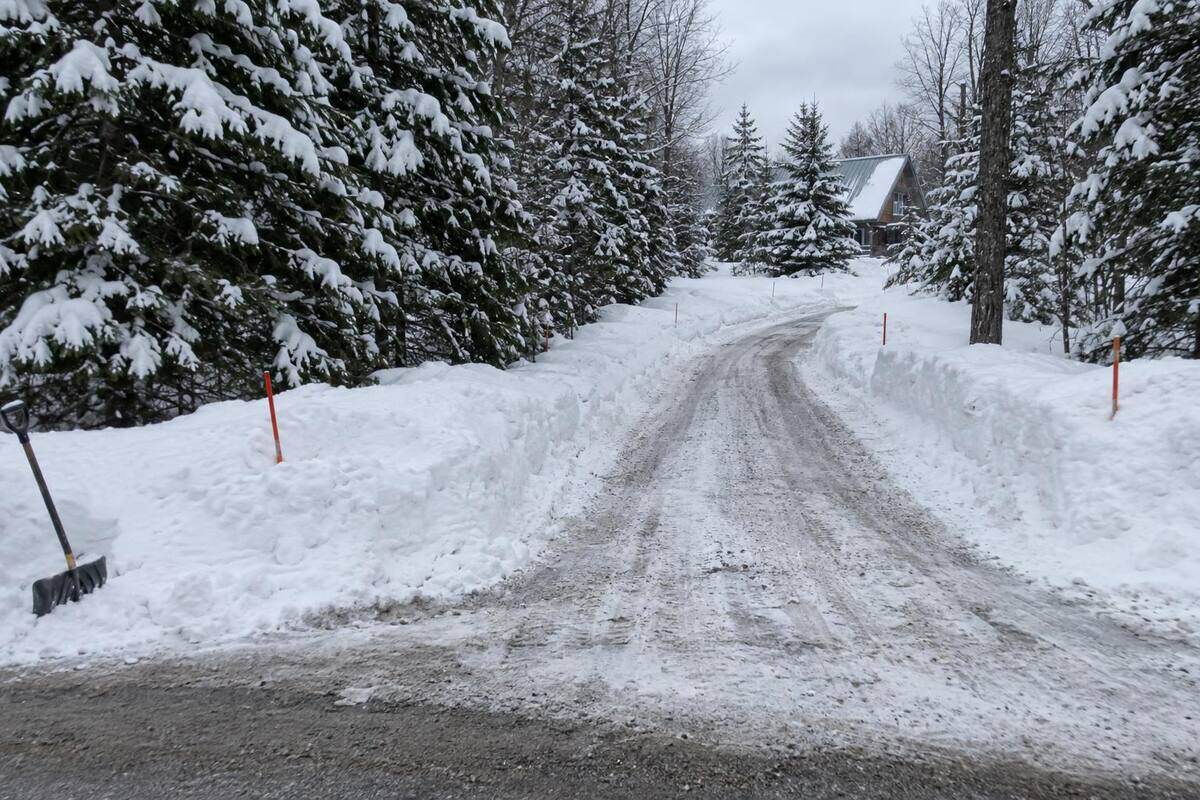
By January the edges of a long drive, the culvert ends and the lawn margins are gone under packed snow. Several local operators stake driveways before the season for exactly that reason, and it is worth asking for even if nobody offers.
An asphalt drive can be plowed close to the surface. A gravel drive cannot be, or the stone ends up in the banks and on the lawn. An operator who knows the drive is gravel sets the blade to ride slightly above it and leaves a thin packed layer on purpose. In a hard freeze that layer is fine. In a thaw it turns to slush over soft stone, and the next freeze locks the ruts in.
Now multiply by the season. At Cherry Capital Airport there are about 32 days a year with an inch or more of new snow, and about 98 days a year with at least an inch on the ground. A contract with a 1-inch trigger on a long gravel drive means something on the order of thirty trips down it in a normal winter, more in the Leelanau uplands, and far more in a winter like 2025–26. Each trip wears the edges and the crown a little. That is why the spring question belongs in the fall contract: who regrades the ruts and puts back the stone that ended up in the lawn, and is it included.
Outside the natural-gas lines, much of this area heats with propane, and the delivery truck has to reach the tank. A drive plowed to the garage but not to the tank pad is a missed delivery. In an empty house, a tank that runs dry is a freeze no thermostat will catch. Put the path to the tank in the contract by name.
High-efficiency furnaces and dryers often vent low on a side wall, right where the plow banks and the drifts build. A vent buried in snow can shut the furnace down. Ask for the vent openings to be checked and cleared on each visit, and point them out on the staking visit.
For a house nobody is living in, these two items matter more than the drive itself. The second-home and vacant-property page covers how a contractor can document them after every visit.
Inside Traverse City, and through the subdivisions and apartments of Garfield Township to the south, the driveway is short and the job is different. Garfield is only 56.2% owner-occupied and the city 63.7%, so a lot of driveways there belong to a landlord or an association. Where the drive is a single-house apron, the difficulty is not length but space: there is little room to put the snow, and the city asks that none of it be pushed into the street or the alley. From November 16 to April 14 the city also bans street and alley parking from 3 to 6 a.m., so the car has to be in the drive when the route comes by. See the Traverse City page and the local rules.
Outside the city, Grand Traverse County’s own winter parking ordinance keeps cars off county roads from midnight to 8 a.m. between December 1 and March 31. On a long rural drive that rarely matters. What matters there is the ridge the county truck leaves across the end of your drive, often after your contractor has already been. That has its own page: the county plow berm across the driveway.
Length, turnaround, slope, surface, stacking room and what sits at the far end: six answers put a long drive in a class an operator can quote.
Call (231) 715-4148 Get a Season Price Traverse City